Same paddy, two different jobs
A rice dehusker and a rice mill are not a small one and a large one. They remove different layers of the same grain, and each stops at a different product.
- A dehusker (also called a huller) removes the husk. What comes out is brown rice.
- A mill, in the sense buyers usually mean, removes the bran from brown rice and whitens it. What comes out is white rice.
If you buy a dehusker expecting white rice, you will have a machine that works perfectly and produces the wrong product. That mistake is common enough to be worth a page.
_caption: Rice processing stages and the machines we publish for each, Gentor Machinery, November 2026_
| Stage | Machine | What comes out | Published spec | Published price |
|---|---|---|---|---|
| Remove husk | Paddy Husker and Rice Huller | Brown rice | 300 kg/h, 2.2 kW | US$500-519 |
| Remove bran and whiten | Vertical Rice Whitener and Polisher | White rice | 2.2 kW | US$480-499 |
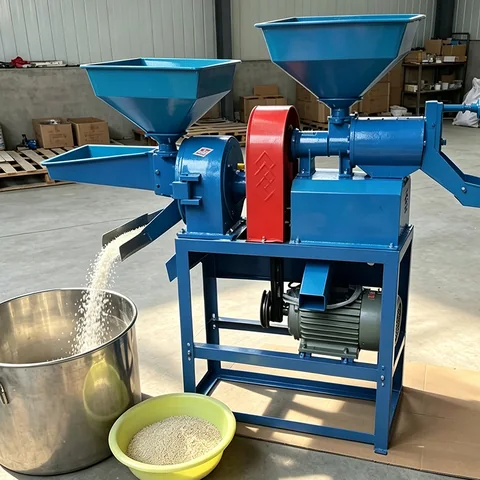
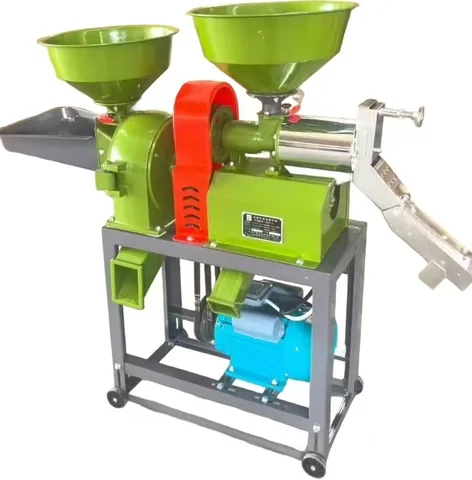
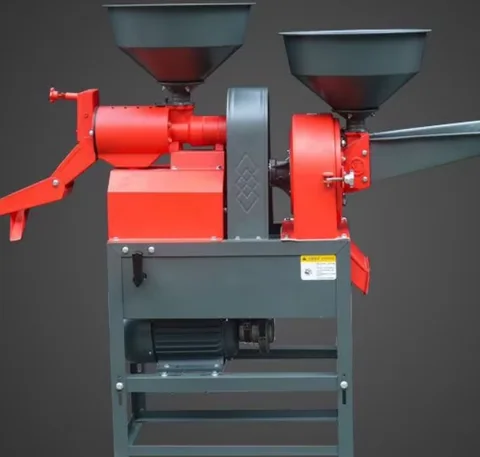
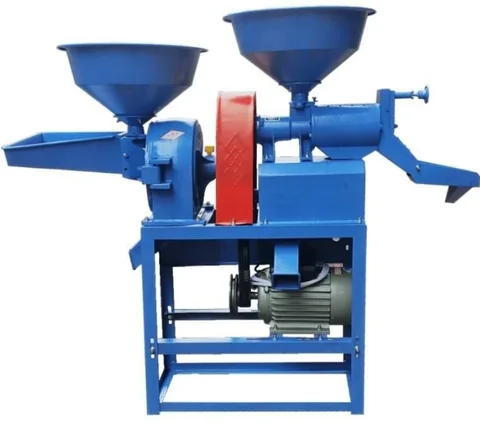
| More than one stage, small scale | Mini Rice Milling Machine with Peeling and Crushing | Milled rice, plus crushed material | Electric, functions combined | US$420-450 |
| One operator, no fixed line | Portable Automatic Mini Rice Mill | Milled rice | Automatic, small-scale duty | US$500-510 |
Note what is and is not in that table. We publish 300 kg/h for the husker because that figure is specified. For the whitener and the two small units we publish power and functions, not throughput - a kg/h number measured on one paddy variety would not hold on another.
What the dehusker actually does
The husk is the outer shell. Removing it is the first transformation from paddy to something sellable, and it is where the bulk of the weight leaves the grain.
Two consequences follow, and both catch buyers:
Brown rice is a product, but a smaller market than white. If your buyers want white rice, the husker is stage one of a line, not a complete business.
Husk is a by-product with a volume problem. Husk is bulky and light; it has to go somewhere. Farms use it for bedding, compost or fuel, but a mill that has not planned for it ends up paying to move it.
What the mill actually does
Whitening removes the bran layer. It is a gentler operation on the grain than husking and it is where breakage shows up: an over-pressed whitener produces white rice with more broken grains, which sells at a lower grade.
This is why a whitener is specified by power and by how it treats the grain, not by throughput alone. The 2.2 kW vertical unit is a finishing stage for a mill that already has husking and separation in place.
When you need both, and when you need one
Brown rice trade: husker only. If the product you sell is brown rice, the 300 kg/h husker is the whole machine you need.
White rice at commercial volume: both stages. The husker feeds the whitener. Buying the whitener first and husking elsewhere means paying someone else for the first stage indefinitely.
Starting small with one machine: the mini units. The mini milling machine with peeling and crushing covers more of the process in a single electric unit. That is its real advantage - not that it is cheaper, but that it collapses several stages into one machine at small scale. What it does not do is produce commercial volume.
The capacity question, answered honestly
A 300 kg/h husker and a whitener of undisclosed throughput cannot be matched from this page. Matching stages is arithmetic on your own numbers: weigh what you husk in an hour, then size the next stage so it does not sit idle waiting.
If you tell us the paddy variety, the moisture you work at and the volume per day, we will answer the capacity question for your case. A generic figure would be a guess dressed as a specification.
What to check before you pay
- Which product you intend to sell - brown rice or white rice. This decides the machine, before any other question.
- Whether the machine you are looking at is a stage or a complete unit. Ask what comes out of it.
- Voltage and phase for your site, confirmed on the proforma invoice.
- Wear parts: screens, rubber rolls and blades. A husker that cannot get rolls stops husking.
- What happens to the husk and bran. Both are outputs, and both need a destination.
Where to see every price we publish
31 of the 32 models we list carry a published figure, including the four rice machines above. Where a model is quoted per order, the page says so rather than showing an estimate.