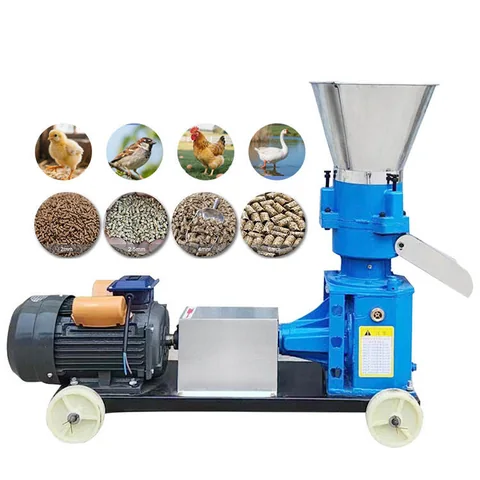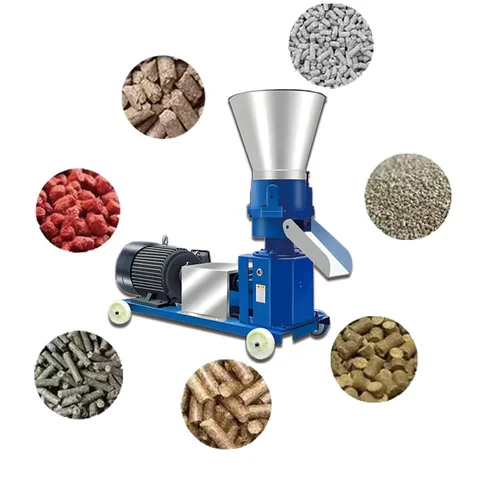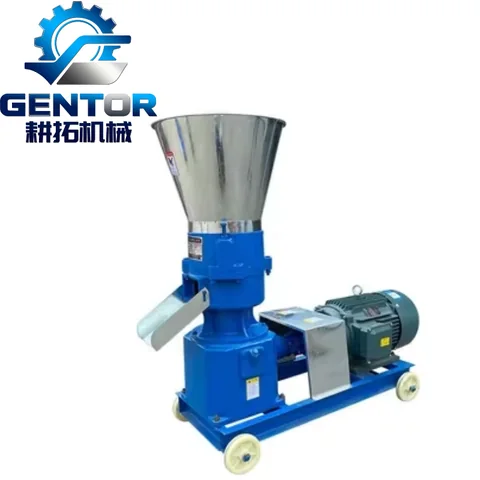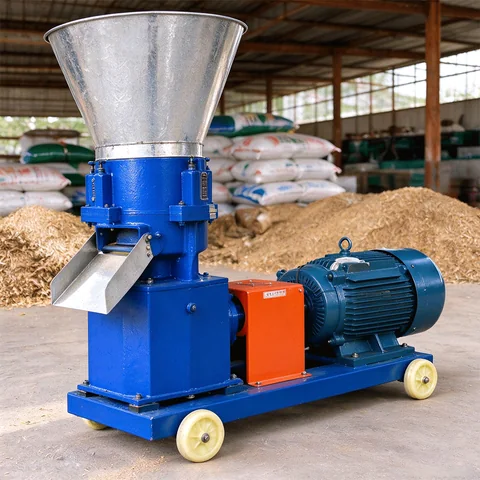
Buyers expect the price of a feed pellet machine to follow its output. In the four models we publish, it does not. The whole range sits between US$275 and US$319 per set, a spread of US$44, and the cheapest unit in it is the one with the highest published throughput.
That is not a pricing trick. It is what happens when four machines are built for four different jobs and the market prices the job rather than the kilogram.
Four models, four roles
_caption: Feed pellet machine price bands, published range, November 2026_
| Model | Die type | Rated throughput | Power as published | Published price |
|---|---|---|---|---|
| Mini Feed Pellet Press | not published | 100 kg/h | Electric | US$300-319 |
| Flat Die Feed Pellet Machine | Flat die | not published | 220 V, 3 kW | US$299-319 |
| Ring Die Feed Pellet Mill | Ring die | 200 kg/h | not published | US$275-288 |
| Mobile Electric Feed Pellet Machine | not published | 120-150 kg/h | Electric | US$280 |
The blank cells are deliberate. Where a figure is not published for a model we say so rather than print a plausible number, and it is the first thing to ask about on a quotation.
The cheapest unit is the highest-throughput one
The ring die pellet mill is the lowest published price in the range at US$275-288, and it is also the highest-throughput model at 200 kg/h. The mini press, at 100 kg/h, is published at US$300-319 — above it.
The reason is the role each machine is sold into. The ring die mill is a pelletising unit meant to sit inside a larger feed line, where the rest of the line already exists and the buyer is buying one stage of it. The mini press is a complete farm-level unit for someone who wants pellets coming out of a single machine. You are not paying for throughput; you are paying for how much machine arrives with it.
Cost per tonne of daily output
_caption: Published throughput converted at 8 hours per day, with the lower bound of the published price divided by tonnes per day_
| Model | Rated throughput | Per 8-hour day | Per 25-day month | Price per tonne of daily capacity |
|---|---|---|---|---|
| Ring Die Feed Pellet Mill | 200 kg/h | 1.6 t | 40 t | US$172 |
| Mobile Electric Feed Pellet Machine | 120-150 kg/h | 0.96-1.2 t | 24-30 t | US$233 |
| Mini Feed Pellet Press | 100 kg/h | 0.8 t | 20 t | US$375 |
| Flat Die Feed Pellet Machine | not published | not published | not published | not published |
Flat die or ring die
The flat die machine is published as a 220 V, 3 kW unit, which is the specification that matters on a farm with single-phase power: it is the one model in the range whose electrical requirement is published at all. If your supply is single-phase and nobody is going to rewire the site, start there.
The ring die mill is the model for a line. A ring die holds a larger die area and is built to run continuously as one stage of a feed plant, which is why its published role is "pelletising unit in a feed production line" rather than a standalone machine.
Which animals the published lists cover
- Mini Feed Pellet Press: chicken, pig, rabbit, duck.
- Flat Die Feed Pellet Machine: cattle, sheep, pig, chicken.
- Ring Die Feed Pellet Mill: cattle, sheep, chicken.
- Mobile Electric Feed Pellet Machine: poultry and livestock.
These are the species each model is published for. They are not a limit on what can be pressed — they are what the model was specified around, and it is a fair question to ask before choosing.
What this range does not cover
Feed mixers, hammer mills and dryers are separate machines and none of them are in our published list. A pellet machine presses; it does not grind the grain first and it does not dry the pellets afterwards. If you are building a line rather than buying one machine, say so and we will tell you which stages we publish and which you have to source elsewhere.
Four questions that decide the model
- Is the machine the whole line, or one stage of it? Whole line points at the mini press or the mobile unit; one stage points at the ring die mill.
- What is the power at the site? Only the flat die model publishes its voltage and phase, at 220 V and 3 kW. For the others the motor is confirmed per order against your actual supply.
- Does it have to move? The mobile unit is wheel-mounted and published for moving between farm sites. A fixed site does not need to pay for that.
- How many tonnes of feed a month, and for which animals? Use the arithmetic table, then check the species the model is published for.
Before you pay
- Ask for the die and roller set with the machine, and the price of a spare. It is the wearing part.
- Confirm the motor against your voltage and phase in writing, before the order is placed.
- Ask which die hole size is supplied, because it is chosen for the pellet size your animals take.
- Confirm how the machine is packed for sea freight, and what the packing list covers.
- Confirm the port and the Incoterm: the published price is per set, and freight is quoted separately.
Where to see every published price
Every model in this article carries its price on its own page, and the whole catalogue is collected in one place — 31 of the 32 machines we publish have a figure, and the rest are quoted per order. If you already have a quote from elsewhere and want it read against ours, send it with your country and destination port and we will confirm price per set, shipping method and lead time in one reply.