A buyer searching for rice mill manufacturers in China for export is usually asking one thing underneath the search: can this factory actually put a machine on a ship, and what does that machine cost at what capacity? The ranking lists that show up first rarely answer either half.
Two questions decide most of it. Can the factory state a power requirement and a packing method, and does it publish figures you can check rather than a price alone?
The four stages, and where our published models sit
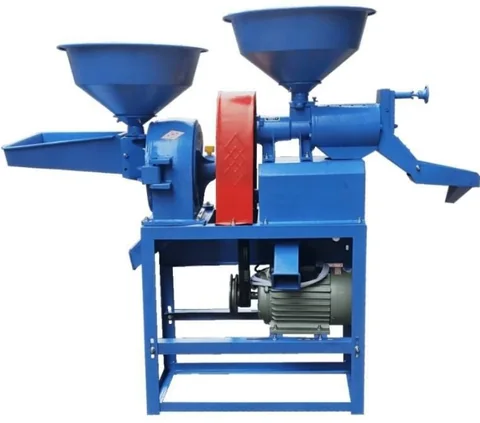
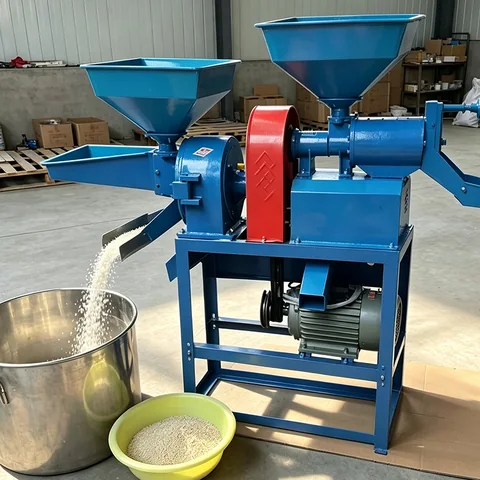
Rice does not become white rice in one pass. De-husking, whitening, polishing and grading are separate stages, and a factory that sells into export markets usually has a model at each one. Ours are published in full, capacity and power included, so the band can be checked rather than assumed.
| Model | Stage it covers | Published price (per set) | Power |
|---|---|---|---|
| Mini Rice Milling Machine with Peeling and Crushing | Milling, with peeling and crushing in one unit | US$420-450 | Electric |
| Vertical Rice Whitener and Polisher, 2.2 kW | Whitening and polishing to finished white rice | US$480-499 | 2.2 kW electric |
| Portable Automatic Mini Rice Mill | Self-contained milling at small volume | US$500-510 | Electric |
| Paddy Husker and Rice Huller, 300 kg/h | De-husking paddy to brown rice | US$500-519 | 2.2 kW electric |
The useful reading of that table is not the price. It is that the whole de-husking-to-whitening sequence for a small mill sits inside a band of roughly four hundred to five hundred and twenty US dollars per machine, before freight. Buyers who expect a complete line at a single-machine price are working from a ranking list, not from a specification.
What changes when the order goes for export
Domestic orders do not touch any of this. Export orders fail on it.
- Power rating against the destination supply. A 2.2 kW machine needs a supply and wiring that carry it. This is the second largest cost after the machine on many installations, and it is avoidable.
- Sea packing, not the packing that survives a truck. Ask how the machine is packed and whether it is crated for container loading.
- Wear parts available at order time. Freight on a small part costs more than the part. Ordering wear parts with the machine is normal practice on rice mills.
- Documents matching one entity. Contract, invoice and payment should name the same legal entity, or documents get queried at destination.
- A named lead time. Not "as soon as possible" — a date and the shipping method it assumes.
The four statements a factory should put in writing
Capacity or throughput, the power requirement, the MOQ, and what the price covers. Where a factory cannot give all four, the comparison cannot be made, because a price without a power figure is not comparable with a price that has one.
We publish these figures for every model on this site, which is the reason this page can be checked rather than taken on trust. If you tell us your daily paddy volume and your destination port, we will tell you which stage to buy first and which model in that band fits — including when the answer is that the model you picked is the wrong stage.