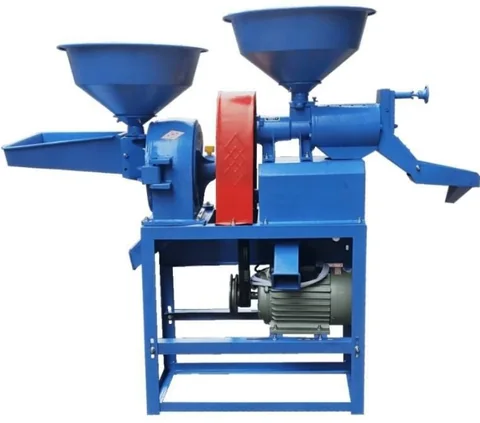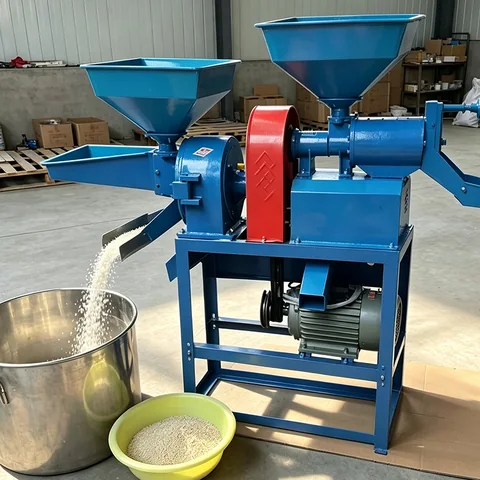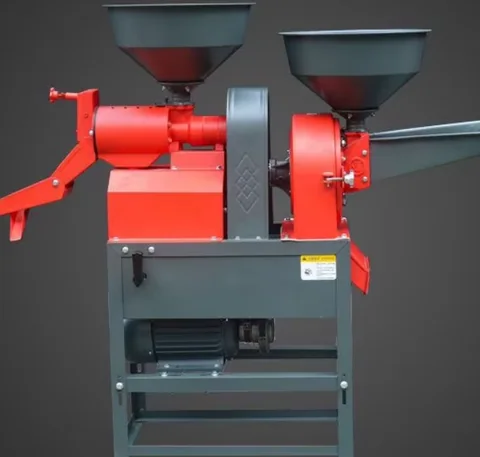
Under US$1,000 buys a real rice mill — but not a complete rice milling line. That distinction is the whole decision, and it is where most first-time buyers spend money twice.
We publish four rice mill models below US$1,000 a set. They do different jobs in the paddy-to-white-rice sequence, so the right question is not "which is the cheapest" but "which stage do I need to stop paying someone else for".
The four published models, side by side
| Model | Stage in the process | Published price (per set) | Power | MOQ |
|---|---|---|---|---|
| Mini Rice Milling Machine with Peeling and Crushing | Milling, plus peeling and crushing in one unit | US$420-450 | Electric | 1 set |
| Vertical Rice Whitener and Polisher, 2.2 kW | Whitening and polishing to finished white rice | US$480-499 | 2.2 kW electric | 1 set |
| Portable Automatic Mini Rice Mill | Self-contained milling at small volume | US$500-510 | Electric | 1 set |
| Paddy Husker and Rice Huller, 300 kg/h | De-husking paddy to brown rice | US$500-519 | 2.2 kW electric | 1 set |
All four are quoted per set, minimum one set. Prices are the published figures for the models listed on this site; they are not a quotation for your destination, because freight, insurance, import duty and any local electrical work sit outside the machine price.
Which one is your bottleneck?
A rice mill is rarely one machine. Paddy becomes white rice through de-husking, then whitening and polishing, then grading. A single small machine covers part of that chain.
- You buy paddy and sell brown rice. The paddy husker is the machine that changes your position — it removes husk, and the output is brown rice you can sell or mill further.
- You already de-husk and want to sell white rice. The whitener and polisher is the finishing stage. Buying it is how a brown-rice operation moves one step up the price ladder.
- You want one unit that does more of the process on site. The peeling-and-crushing model bundles milling with peeling and crushing, which is useful where feed and food preparation happen on the same holding.
- You need something a single operator can move and run. The portable automatic mill is sized for that, rather than for a fixed mill line.
If you are choosing on throughput rather than stage, start from the volume of paddy you can actually secure per day — not from the biggest number in a catalogue. Our capacity guide walks through that arithmetic against the capacities we publish.
What the price does not include
This is the part that decides whether an under-US$1,000 machine stays under US$1,000 landed.
- Freight to your port, and inland movement after clearance.
- Import duty and taxes at destination. These are set by your own authorities, not by us, and we do not estimate them for you — your clearing agent gives you the figure.
- Electrical work on site. A 2.2 kW machine needs a supply that can carry it, plus wiring and protection. Confirm the supply before you order, not after.
- Spare parts you may want on hand, particularly wear parts for the milling chamber.
Ask every supplier the same four questions — price per set, power requirement, what the price includes, and lead time in writing. A quotation that omits the power requirement cannot be compared with one that states it, because the electrical work is often the second largest cost after the machine itself.
What we need from you to quote properly
Send the machine you are considering, your country and your port. We reply with the model, the price per set, and the shipping method to that port. If you tell us how much paddy you handle per day, we will tell you if the model you picked is the wrong stage — which is a cheaper conversation to have before the order than after it.